Practical digital marketing lessons for fisheries and aquaculture innovators—from understanding the market to building visibility, trust and consistent growth
Early-stage founders are often told to create a website, post on every social platform, run advertisements, produce videos and start using AI—all at the same time. For a small team still validating its product, this creates activity without necessarily creating progress.
A better starting point is much simpler: understand the customer problem, make the business easy to trust, choose a small number of suitable channels and use them consistently.
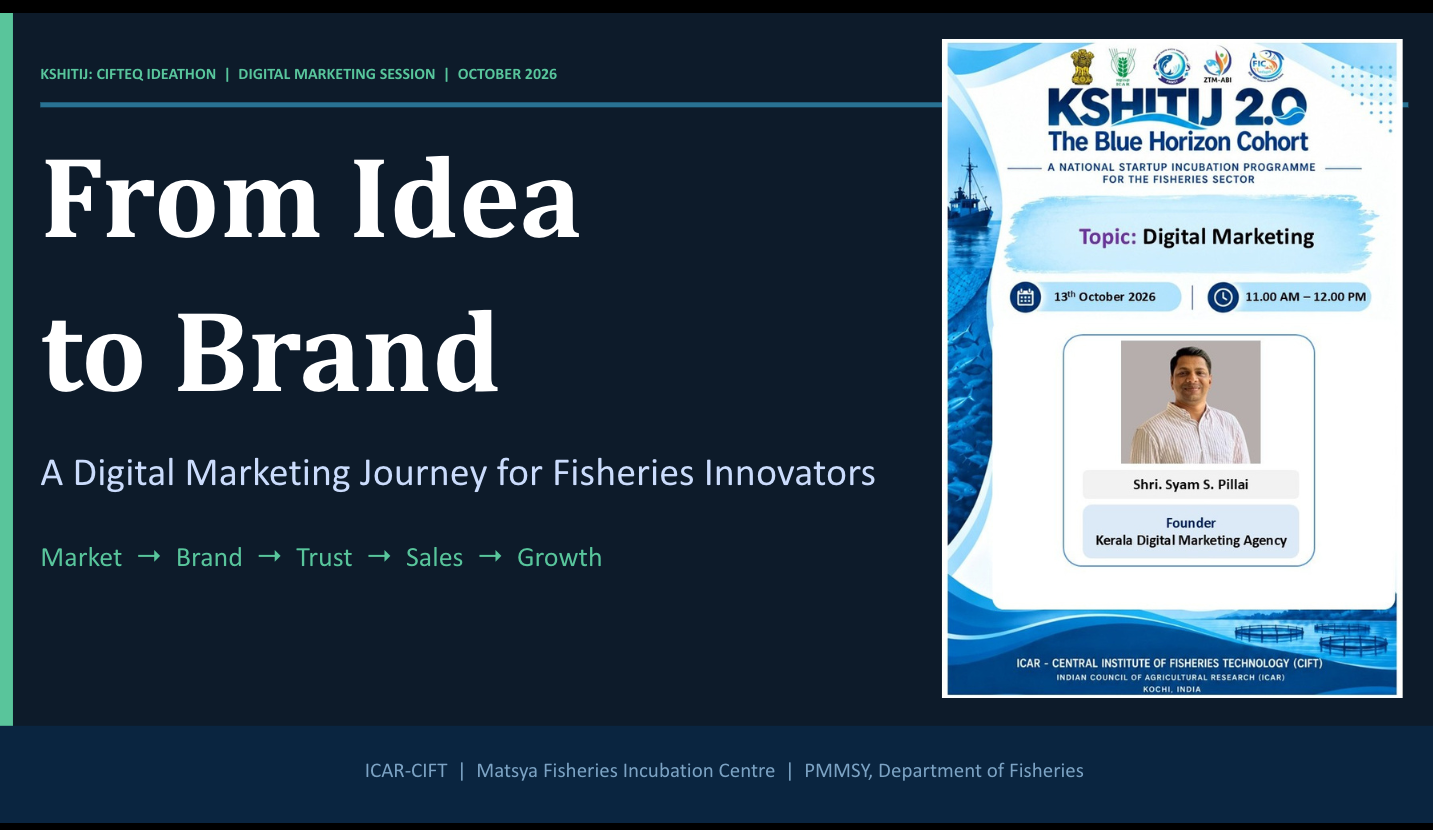
This practical approach formed the foundation of a 1.5-hour digital marketing training session delivered by Syam S Pillai for participants in KSHITIJ 2.0 – The Blue Horizon Cohort and CIFTEQ Ideathon, conducted through the incubation network of ICAR–Central Institute of Fisheries Technology (ICAR-CIFT), Kochi.
Rather than treating digital marketing as a collection of tools, the session presented it as a working system that helps a founder answer four questions:
- Who is the business trying to reach?
- What problem does that customer need solved?
- What proof will make the offer believable?
- Which channels can the founder manage consistently?
Marketing Starts Before Promotion
Many founders think marketing begins when they create a logo, launch a website or open a social media account. In reality, marketing begins much earlier—with decisions about the customer, the problem, the offer and the reason someone should choose the new venture over an existing alternative.
This is especially important for businesses emerging from scientific research, product development or technical innovation. A technically strong product can still struggle commercially if the founder cannot explain its value in the customer’s language.
Before deciding how to promote a fisheries or aquaculture venture, a founder should first establish:
- The specific customer group the business intends to serve
- The practical problem experienced by that customer
- The alternatives already available in the market
- The measurable benefit offered by the proposed solution
- The evidence that customers are willing to try or pay for it
A fish farmer considering a new feed product, for example, may not initially respond to a long explanation of formulation technology. The questions that influence the decision may be more immediate: Will it improve growth? Will it reduce waste? Is the supply reliable? Has it been tested under conditions similar to the farmer’s own operation?
The marketing message should begin with those customer concerns. The technical explanation can then support the promise instead of replacing it.
A Simple Validation Routine
Early market research does not always require an expensive survey or specialist agency. Founders can begin with direct conversations and structured observation.
A useful validation routine includes:
- Speak with potential customers, distributors, retailers and sector professionals.
- Record the words they use to describe their problems and priorities.
- Study how they currently discover, compare and purchase similar products.
- Identify the objections that repeatedly delay a purchase decision.
- Test a clear offer with a small customer group before investing heavily in promotion.
This process produces more than market information. It gives the founder the raw material needed for product positioning, sales presentations, website copy, search content, demonstrations and social media communication.
What FreshToHome Demonstrates
FreshToHome offers a particularly relevant example for innovators connected to fisheries and fresh-food value chains. Founded in 2015 by Shan Kadavil and Mathew Joseph, the business developed around the demand for fresh, preservative-free meat and seafood and communicated that value through the memorable promise “100% Fresh, 0% Chemicals.”exchange4media
That promise works because it addresses a customer anxiety rather than merely describing a sales channel. “Order fish online” explains a transaction; “100% Fresh, 0% Chemicals” explains why a customer should trust it.
The earlier SeaToHome experience also shows the importance of validation. Shan Kadavil has explained that although SeaToHome did not scale because the necessary technology infrastructure was not available, it helped reveal customer demand for affordable, technology-enabled access to clean meat and seafood.india.entrepreneur
The lesson for a young venture is not to imitate FreshToHome’s current scale. It is to notice the sequence behind the brand:
- A recognised customer problem
- A clear and repeatable promise
- Operational systems capable of supporting that promise
- Consistent proof that reduces purchase anxiety
A strong message cannot compensate for a weak product. At the same time, a strong product cannot grow if customers do not understand why it matters.
One Channel Can Create Momentum
Physics Wallah demonstrates what can happen when a venture uses one channel consistently and aligns it closely with the audience’s needs. The initiative began its journey as a YouTube channel in 2016, offering coaching for JEE and NEET aspirants, before expanding into an app and a broader education platform.pw+1
YouTube was not simply a place to advertise paid courses. It allowed students to experience the teaching, assess its usefulness and develop familiarity with the educator before making a purchase decision. The content itself created visibility and trust.
For an early-stage founder, this suggests an important principle: the best channel is not necessarily the most fashionable platform. It is the place where the business can repeatedly demonstrate value to the right customer.
For example:
- A fish-processing equipment venture could use LinkedIn and its website to publish demonstrations, operating data and institutional proof.
- A value-added seafood brand could use Instagram and WhatsApp to show the product, explain preparation and convert interest into direct enquiries.
- A local fresh-fish business could prioritise Google Business Profile and WhatsApp for discovery, reviews, repeat orders and customer communication.
- A technology or knowledge-led venture could use YouTube and its website to explain processes that customers need to understand before buying.
Trust Can Be a Growth Channel
Zerodha provides a different model. The company has publicly stated that it does not advertise and that 25% to 30% of its accounts still come through referrals, with users recommending the platform to friends and family.zerodha
This is not a reason for every founder to reject advertising. It demonstrates that product experience, transparent practices, useful education and customer advocacy can reduce dependence on paid customer acquisition.
Trust is especially important in fisheries and aquaculture, where customers may need confidence in quality, safety, technical performance, sourcing, traceability, handling or compliance. A founder should therefore treat proof as part of marketing rather than as information to be added later.
Useful forms of proof can include:
- Founder experience and field knowledge
- Product trials and documented outcomes
- Incubation or institutional association
- Technical guidance received from credible organisations
- Certifications, licences and test results
- Customer feedback and repeat purchases
- Photographs or videos showing the process honestly
- Clear business address and contact information
- Transparent explanations of what the product can and cannot do
KSHITIJ 2.0 itself is designed to provide innovators with mentoring, technical guidance, access to fisheries technologies, business networking, industry connections and certification. Participants should communicate relevant achievements from this process accurately across founder profiles, pitch decks, websites and professional social channels.cift.res
Choose Two Channels First
The temptation to be present everywhere is one of the most common digital marketing problems for small businesses. A founder creates accounts on several platforms, publishes for a short period and then becomes too busy to continue.
A more sustainable rule is to select two primary channels based on the customer journey.
| Business situation | Primary channel | Supporting channel | Main purpose |
|---|---|---|---|
| Local fresh product or repeat-purchase business | Google Business Profile | WhatsApp Business | Local discovery, reviews, enquiries and repeat orders |
| Consumer food brand | WhatsApp Business | Product discovery, visual proof and direct conversion | |
| B2B technology or equipment venture | Website | Professional visibility, detailed proof and lead generation | |
| Education or process-led venture | YouTube | Website | Explanation, demonstration and searchable resources |
| Bulk supply or distributor-focused business | Trade portal | Buyer discovery, credibility and partnerships | |
| Research-based innovation | Website | Technical documentation, institutional proof and stakeholder communication |
Owning a channel means more than opening an account. It requires a publishing rhythm, useful information, quick responses, accurate business details and regular review of what produces meaningful enquiries.
A third channel should be added only when the first two are operating reliably. Expansion should follow evidence, not anxiety.
Build a Minimum Trust System
Before increasing content output or advertising expenditure, a startup should establish a basic digital trust system. This gives potential customers enough information to decide whether the business deserves further attention.
The minimum system can include:
- A clear description of the problem being solved
- A concise explanation of the product or service
- The intended customer or use case
- Founder and team information
- Relevant technical, institutional or incubation credentials
- Photographs, demonstrations or product evidence
- Frequently requested practical information
- A visible phone number, email address or enquiry method
- A specific next step, such as requesting a sample, booking a demonstration or speaking with the founder
This does not require a large website. A focused website with accurate information and credible proof can be more useful than a visually impressive site filled with generic claims.
Content Should Answer Decisions
Founders often ask what they should post. The answer becomes clearer when content is organised around the decisions a customer must make.
A practical content system can cover five areas:
- Problem content: Explain the customer problem, its cost and why existing practices may be insufficient.
- Solution content: Show how the product, process or service works in plain language.
- Proof content: Share demonstrations, test findings, customer experience, field activity and credible milestones.
- Objection content: Address concerns about price, safety, reliability, use, availability or after-sales support.
- Founder content: Share the experience, observations and purpose behind the venture without turning every post into self-promotion.
For example, a startup developing sustainable fish packaging could create content about spoilage, leakage, transport conditions, material performance, disposal and the commercial cost of packaging failure. These topics are more useful to a buyer than a continuous stream of posters stating that the company offers an “innovative solution.”
Use AI Without Losing Accuracy
AI tools can reduce the time needed to organise research, develop a first draft or adapt information into different formats. They are especially helpful when a small team has limited marketing capacity.
Founders can use AI to:
- Organise notes from customer interviews
- Develop an initial customer profile
- Group recurring customer questions
- Draft product descriptions and FAQs
- Generate ideas for demonstrations and educational content
- Adapt a detailed explanation into a short social post
- Prepare WhatsApp follow-up messages
- Translate a reviewed message into regional languages
- Build a basic monthly content plan
- Compare how competitors explain similar products
The founder must remain responsible for the facts. Technical claims, prices, performance statements, safety information, regulatory details and customer evidence should be verified before publication.
AI is most valuable as a drafting and thinking assistant. It should not become an automated source of unsupported claims.
Create a Weekly Operating Rhythm
Consistency becomes easier when marketing is treated as a small operating system rather than an occasional campaign.
A realistic weekly routine for an early-stage founder could be:
- Daily: Respond to messages, comments and enquiries.
- Twice a week: Publish one useful explanation, demonstration, observation or proof item.
- Weekly: Speak with at least one customer, buyer, distributor or domain expert.
- Weekly: Update one business asset, such as a product page, founder profile, presentation or Google Business Profile.
- Monthly: Review which activities generated qualified calls, messages, meetings, samples, trials or orders.
The objective is not to produce the highest volume of content. It is to stay visible, useful and responsive long enough to learn what influences the market.
Measure Business Signals
Likes and follower counts can indicate attention, but they do not always show commercial progress. Early-stage founders should connect digital activity to the next meaningful business action.
Depending on the venture, useful measures may include:
- Qualified enquiries received
- Product samples requested
- Demonstrations booked
- Distributor conversations started
- Website visits to important product pages
- WhatsApp conversations initiated
- Repeat orders or repeat enquiries
- Customer questions that reveal buying intent
- Referrals from existing contacts or customers
A small audience containing the right buyers, partners or advisors can be more valuable than a large audience with no connection to the offer.
From Incubation to Market
KSHITIJ 2.0 is a national-level incubation and mentorship initiative for fisheries and aquaculture innovation. Eight ICAR fisheries institutes conducted 35 boot camps and onboarded 270 applicants, with ICAR-CIFT serving as the hub institute.icar.org+1
The programme combines two months of virtual incubation with need-based physical incubation, pilot testing, field validation and mentoring for selected participants. Its scope includes aquaculture, harvest and post-harvest technologies, value addition, waste utilisation, fish health, aquafeed, cold chain, packaging, business development, regulatory compliance, marketing and intellectual property.icar.org
The participants therefore represent more than one kind of founder. Some are validating an idea, while others are developing prototypes, preparing pilots or moving towards commercialisation. Their marketing requirements differ, but the sequence remains broadly useful:
- Understand the market.
- Define the customer problem.
- Clarify the offer.
- Build credible proof.
- Select two suitable channels.
- Publish and respond consistently.
- Review real business signals.
- Improve the product and communication together.
Digital marketing cannot replace product validation, technical quality or customer service. It can make each of them easier for the market to discover, understand and trust.
Access the Training Presentation
The presentation used for the KSHITIJ 2.0 digital marketing session is available as a PDF for participants, founders, incubators, students and professionals who want to revisit the framework.
Download the KSHITIJ 2.0 Digital Marketing Presentation (PDF)
The presentation covers market understanding, brand visibility, trust building, suitable channel selection, customer retention, AI-assisted marketing and continuous skill development for early-stage ventures.
About the Trainer
Syam S Pillai is a digital marketing strategist, trainer and founder of Kerala Digital Marketing Agency. With more than 15 years of practical experience, he works across digital marketing strategy, SEO, local search, WordPress website planning, content systems, organic business growth and AI-assisted marketing. Visit Syam S Pillai Linkedin Profile Here
His training approach focuses on explaining digital marketing in plain language and helping entrepreneurs, students, professionals and early-stage founders convert broad marketing concepts into practical actions they can continue after a session.
For customised digital marketing training, startup mentoring or business strategy support, contact Kerala Digital Marketing Agency.